

Blogs: Alumni, Latest Blogs
Reach alumna at the University of Melbourne launches Indigenous-centred coaching program for Reach Alliance researchers
University of Melbourne Reach researchers taking part in an “On Country” day at Melbourne’s Royal Botanic Gardens.
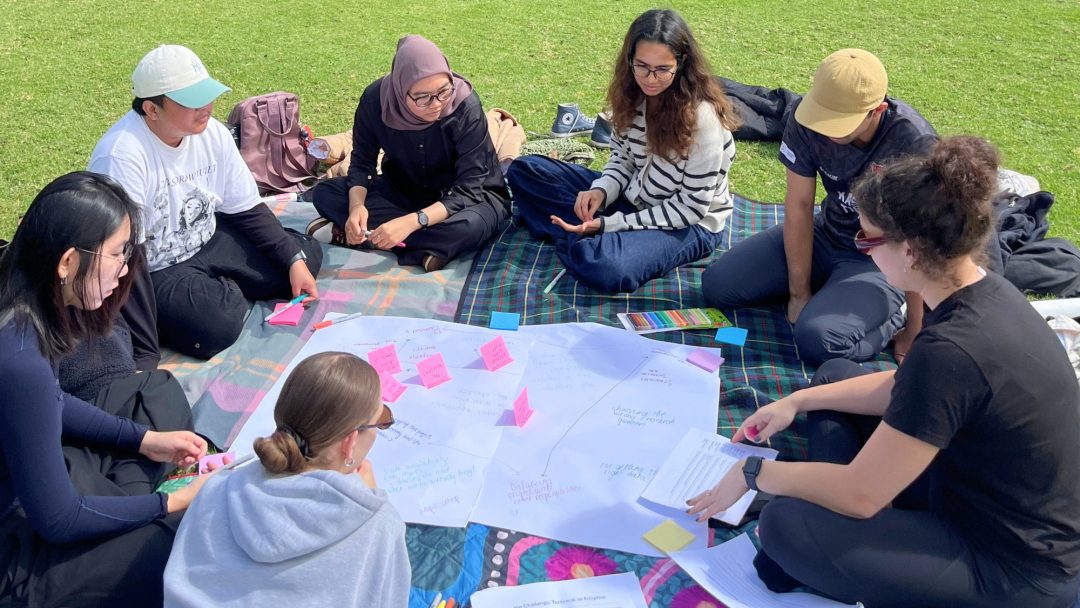
A localized leadership program at the University of Melbourne is integrating Indigenous worldviews into how Reach Alliance researchers learn, collaborate, and engage with communities
By: The Reach Alliance
What does it mean to bring an Aboriginal worldview into the work that you do?
For Tully Mahr, that question has guided a career spanning engineering, aerospace, and community-based research — and is now shaping how Reach Alliance researchers at the University of Melbourne learn to lead.
Mahr, a Master of Mechanical Engineering (Aerospace) student at the University of Melbourne and an on-site Leadership Development Specialist with non-governmental organization Kindred, has developed a new Indigenous-centred coaching and leadership program for Reach Alliance researchers. The program is designed to help students build stronger relationships, engage more meaningfully with communities, and rethink leadership through an Indigenous lens.
The initiative emerged from a growing recognition that effective research must be grounded in local context. Each Reach Alliance team at the University of Melbourne collaborates with Kindred, a Queensland-based organization that emphasizes co-creation and relationship-building in community-based work. By understanding people as part of broader systems, networks, and relationships, researchers are better equipped to grasp the realities communities face and respond in ways that are both relevant and respectful.
In response, the University of Melbourne proposed creating a localized coaching model and invited Mahr to lead its development. Over the summer, she worked with Kindred, the Reach Alliance, and Sealy Coaching to build a program grounded in Indigenous ways of knowing, learning, and relating. At its core is the belief that both leadership and research are fundamentally relational.
“This leadership program stands apart because it is grounded in Indigenous leadership and ways of knowing,” said Adrian Little, former Pro-Vice Chancellor International at the University of Melbourne.
“Embedding Indigenous values, ethics, and ways of leading across every Reach team is foundational to our work and essential to the future we are building.”
One of the program’s defining features is an “On Country” day, which takes students outside the classroom and into spaces where they can connect with culture, land, and one another. During the experience, students participated in a cultural tour through Melbourne’s Royal Botanic Gardens led by Aboriginal Programs Facilitator Jakobi, learning about waterways, flora, fauna, and the interconnectedness between people and place. The program goes beyond just using an Indigenous lens — it gives students to experience the culture in the same way.
“You can tell people these things in a classroom,” Mahr said, “but you can’t actually feel it.”
For Mahr, the experience is about creating an environment where students can show up as whole people rather than separating their professional and personal identities. That emphasis on relationship-building has already resonated with students, including one participant who shared that the program made them feel more comfortable bringing their own culture and identity into their work.
“Existing as an Aboriginal woman, I don’t often see my worldview reflected in the work that I do,” Mahr said. “There are so many values within Indigenous knowledge systems that I would love to see recognized as wisdom, not just traditional knowledge.”
Mahr’s connection to Reach Alliance began in 2024 as a student researcher focused on grassroots recycling and community-led sustainability initiatives in Chile, where fieldwork reshaped her understanding of community-based research. She later emceed the 2024 Reach Conference in Toronto and continued to expand her engineering expertise through interdisciplinary collaboration and community-engaged work.
“My experience with Reach, particularly through fieldwork, grounded me in what you’re doing, why you’re doing it, and who you’re doing it for,” she said.
Now, she hopes this localized coaching model can inspire Reach teams at the University of Melbourne and beyond to engage more deeply with local communities and Indigenous knowledge systems.
“The skills you develop locally can translate globally, even when contexts differ,” Mahr said. “These foundational principles are transferable and can be applied in different settings and communities. They help us better approach and understand new environments.”
This development reflects a growing recognition within the Reach Alliance community that meaningful global work begins with deep local engagement. By grounding research and leadership development in community relationships and Indigenous ways of knowing, University of Melbourne partners bring to life a model that is both context-sensitive and globally relevant.
More Alumni
-
Blog
The Reach Alliance as a Model for 21st Century Teaching and Research
29/09/2026
-
Blog
Reach’s Alumni Council Continues to Shape the Future of the Alliance
10/08/2026
-
Blog
From Student Researcher to Emerging Leader: Celebrating Nice Cailie Ineza on International Youth Day