

Blogs: Latest Blogs
A Reach Alliance Series: Pathways from Evidence to Action
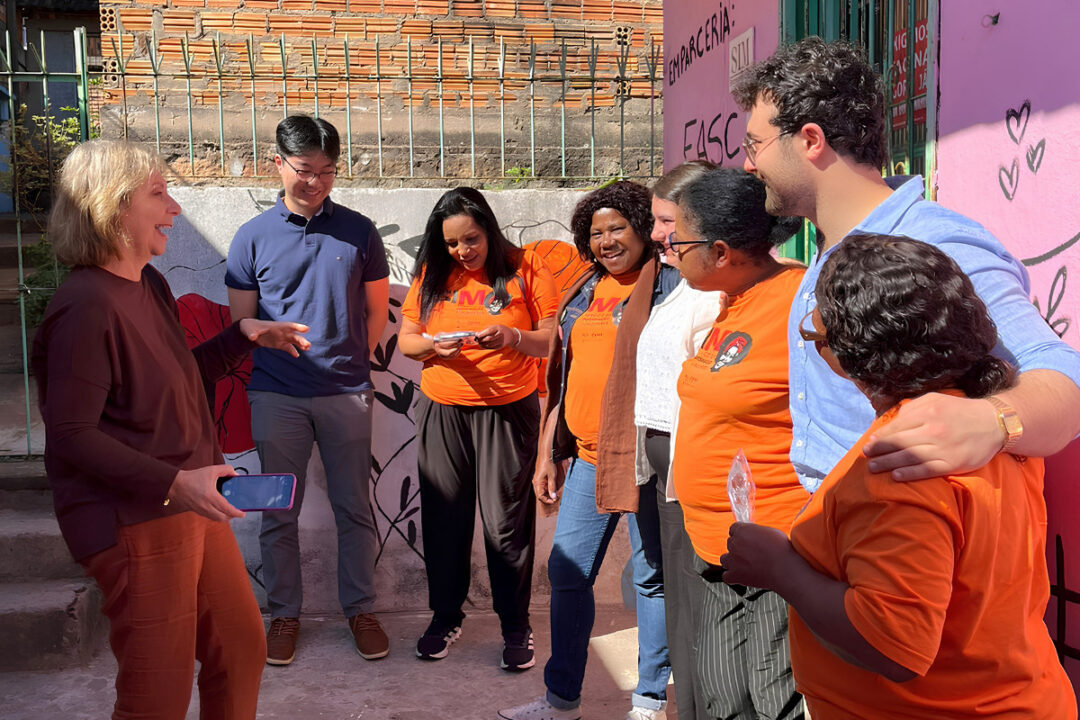
2024–25 University of Toronto Reach Alliance team conducting fieldwork in Brazil with Themis—Gender, Justice, and Human Rights, a nonprofit NGO.
How Reach Alliance research underpins real-world change
By: The Reach Alliance
How can research lead to real-world change? Strong evidence is essential, but its greatest impact comes when findings are translated into practical solutions that inform policy, shape decision-making, and support action. Bridging the gap between knowledge and implementation is one of the most important—and often most challenging—steps in the research process.
This provocation is at the heart of a new Reach Alliance series, Pathways from Evidence to Action. The series challenged researchers to move beyond their research report findings and to consider how their research could help close implementation gaps, uncover new opportunities, and generate actionable recommendations for decision-makers.
“Reach Alliance teams are full of exemplary researchers. They, in just a year, deeply understand a problem, build meaningful collaborations and partnerships, collect primary data, and share their findings with a global audience,” said Purva Mehta, Programs Officer at the Reach Alliance and project lead of the series.
“But how do we move from identifying solutions to creating impact?”
The result is a collection of thirteen briefs addressing some of today’s most pressing climate, public health, and economic challenges. Each brief builds on existing Reach research from across the world to offer practical pathways for implementation, with a focus on what it takes to move from evidence to action. By bringing researchers, practitioners, and policymakers into conversation, the series aims to spark collaboration and support more effective, equitable, and locally informed solutions.
The series was inspired by the African Center for Equitable Development’s (ACED) work reimagining traditional policy briefs as solution briefs. Rather than simply summarizing research for policy change, ACED proposed solution briefs as a knowledge-sharing tool that makes evidence more accessible and actionable for decision-makers and practitioners by focusing on implementation. They ask not only what the research found, but how those findings can be applied to address real-world challenges.
Pathways from Evidence to Action reflects a core principle of Reach’s work: research should lead to practical solutions that create tangible impact for communities. That impact can shape policy, strengthen partnerships, accelerate innovation, and improve implementation at the local level.
“We constantly challenge our researchers to answer the ‘so what’ of their work, particularly as they communicate their findings to diverse audiences across multiple platforms,” said Mehta.
“Creating this series was a natural extension of that approach. It provides a resource that can be shared widely with stakeholders who are well positioned to put evidence into practice.”
Together, the series demonstrates that impactful research goes beyond generating knowledge. By bringing researchers, practitioners, and policymakers into conversation, Pathways from Evidence to Action fosters collaboration that turns evidence into more effective, equitable, and locally informed solutions.
Explore the full Pathways from Evidence to Action series by section:
Economic
- Cash Before Crisis: Blockchain Enabled Anticipatory Action for Vulnerable Populations in Nepall by Kamal Al-Alwan, Arushi Dahiya, Laura Hochheim Thomé, and Vedant Iyer; University of Toronto
- Digital Transformation to Advance Financial Inclusion: Breaking Barriers to Access and Equity by Gavriella Flores, María Julieta Lomelí Lugo, and Renée Marie Gott Suárez; Tecnológico de Monterrey
- Utilizing Conversational AI to Enhance Financial Literacy for Migrant Workers in Singapore by Alexander Tsai Yih Rae, Arif Ahmad Woozeer, Caroline Cheng Hui Xuan, and Gigi Foo Wan Qi; Singapore Management University
Climate
- Beyond the Crisis: Community-Led Water Governance as a Model for Environmental Sustainability by Alan Huerta, Alejandra Sánchez Navarro, Alexa Allamand, and Mariano Hernández Osuna; Tecnologico de Monterrey
- Community-Driven Recommendations for Agricultural Technology Adoption in Underserved Farming Communities by Ashna Jain, Melisa Marin, and Milad Naeimi; University of Toronto
- Deep Seabed Mining: Environmental Risks, Social Consequences, Responsible Governance by Santiago Colin, Emiliano Bondani Rahme, Julia Guzman Gutierrez, and Sofia Villegas Perez; Tecnologico de Monterrey
- Recommendations for Integrating Women’s Lived Experience into Equitable Climate Responses by Harriet Brown, Anando Ghosh, Richard Müller and Megha Zavar; University College London
Public Health
- A Blueprint for Change: Strengthening Community-Based Legal Empowerment to Improve Justice Outcomes for Women by Samantha Misner, Thuraya Abdul Hamid, and Luke Lee; University of Toronto
- Connecting Teachers in Country: The Kowie Card’s Community-Led Approach to Educational Retention by Safana Ahmad, Violet Denham-Blau, Ashi Khetan, Aisyah Mohammad Sulhanuddin, Mrish Muralidharan, and Thiri Hlaing Yang; University of Melbourne
- Promoting Equitable Eye-Health Data Sharing by Anna Hoang, Hiranmayee Sudarsan, Marie Cilliers, and Sancia Lam; University College London
- Rethinking Dengue Control: A Biological Pathway to Protecting Hard-to-Reach Populations by Paulina Navarro, Pamela Guzmán, Emilio Romero, and Aitor Rodriguez; Tecnologico de Monterrey
- Technology for Preventative and Inclusive Healthcare by Nana Akua Gyaaba Dickson, Ashesi University; Khyati Eda, University of Toronto
- Unconventional Paths: A Way Forward: Innate Paths, Local Power by Natasha Haffajee, University of Cape Town
The “Pathways from Evidence to Action” series is inspired by the African Center for Equitable Development (ACED). The Reach Alliance challenged researchers to identify connections, address gaps, and develop recommendations grounded in their findings. The series comprises thirteen briefing notes developing solutions for urgent climate, public health, and economic challenges and engages practitioners and policymakers in advancing pathways to implementation.
More Latest Blogs
-
Blog
The Reach Alliance as a Model for 21st Century Teaching and Research
29/09/2026
-
Blog
Reach’s Alumni Council Continues to Shape the Future of the Alliance
10/08/2026
-

Blog
From Student Researcher to Emerging Leader: Celebrating Nice Cailie Ineza on International Youth Day