

Commentaries
A Consequence, Not a Prophecy: Reach As a Knowledge Network
A Consequence, Not a Prophecy: Reach As a Knowledge Network
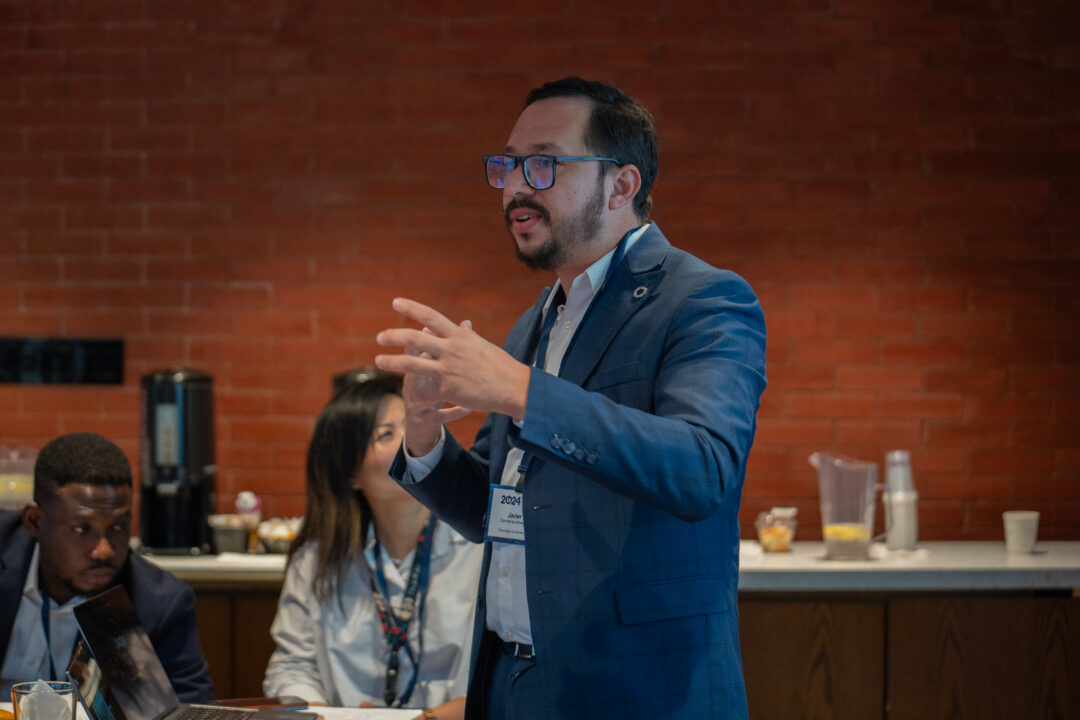
Author: Javier Contreras Arreaga, Tecnológico de Monterrey
Julius Mugwagwa asks whether Reach is the model for teaching and research in the twenty-first century.[1] My answer, drawn from mentoring three different Reach teams in Mexico and from a parallel life running legal clinics, is that the arrow of time may point the other way. Reach is less a prophecy about the university of the future than a consequence of what a particular community of practitioners already knew.
Reach As Distillation, Not Hypothesis
It is tempting to read Mugwagwa’s provocation as describing a bet: a wager on relational capabilities placed in advance of the evidence. My impression is the opposite. Reach was not designed by educational theorists imagining a model that had never been tried. It was designed by people with long experience in policy influence and solution design who had spent careers negotiating with governments, communities, and funders, and who then asked a formative question: can we build these profiles deliberately, at university scale, rather than leave them to be acquired accidentally over fifteen years of professional life?
That origin changes what Reach can honestly claim. Its commitments with interdisciplinarity, fieldwork, co-creation, and tolerance of ambiguity are not discoveries but the codification of a craft. Jorge Membrillo is right that challenge-based learning operationalizes this ethos, and I also agree with Adrian Little as he claims that relationality has far older sources than the twenty-first-century academy.[2] I would add a third genealogy. Clinical legal education has been collapsing teaching, research, and service for over a century, confronting nearly every dilemma this series treats.[3]
So my honest claim is not that Reach invented any of this, but that it’s an incredible platform on which these separate traditions can find one another. It’s not a lesser achievement. It may well be the greater one.
Not for Everyone
I agree with Iza Sánchez that this model is not for every student or every professor, and I would push the point further: it has never pretended to be.[4] Reach is competitive by design, and it selects for a rare combination of strong research capability together with political management skill. The ability to open a door at a ministry, read an institutional room, and keep a stakeholder engaged when the data does not arrive is as decisive as methodological rigour.
This leads to a more uncomfortable observation about how the model actually runs, at least in Mexico. The connections that make our projects possible are frequently not the university’s; they are the faculty mentor’s. It is the mentor’s accumulated relational capital that secures the interview with the state agency, the access to the shelter, the trust of the civil society partner. Dilip Soman calls Reach second-last-mile work building the conditions that let solutions travel.[5] Much of that second-last mile, in our case, is not institutional at all. It is personal, privately held, and generously lent.
Two consequences follow. The model is more fragile than it appears: what depends on individuals does not automatically survive them, and Iza’s point about unrecognized workload is the same problem from another angle, because we ask mentors to contribute an asset the institution neither measures nor insures. And we should be candid about what students receive. What we run is usually a research experience rather than research in the full sense: a formative encounter with the conditions of inquiry, compressed into an academic cycle.
What We Have Not Yet Named: The Knowledge Community
Here is what I find missing so far. My colleagues have written well about pedagogy, ethics, relationality, and artificial intelligence. Few have discussed what Reach does most deliberately and, to my mind, best: it builds a knowledge community, and it builds it on purpose.
Selection, training, mentoring, coaching, the deliberate positioning of researchers, the publication of reports, the conference, the insistence that what a team produces should outlive the team: all of these are not administrative packaging, but the pedagogy. Reach treats research as a membership in a community rather than as the output of a project.
This has changed how I understand my own work as a teacher, and it is the most valuable thing Reach has taught me. It is easy to teach research as method; it is much harder to induct students into a community with standards, memory, obligations, and an audience. That is what a network provides and a course cannot. It is also why Reach works so well as a connector: a legal clinic or a long-standing civil society partnership can plug into it and acquire a memory and an audience it did not have alone. One of Reach’s most attractive functions is that it makes other people’s good work legible to each other.
The Real Test
Which brings me to the risk my colleagues have rightly placed at the centre: academic tourism and extractivism. The antidote is not primarily an ethical protocol (nearly every extractive project I have encountered was formally consented to).
The antidote is continuity, and continuity is a property of networks rather than projects. A single cohort cannot avoid extraction because a single cohort cannot return. Ana Elena Fierro’s proposal that each generation should inherit relationships, data, and unfinished questions from the last is the most important operational idea in this series.[6] Clinics solved this through the case file: the matter persists across student generations, and the duty is held by the institution, not the student enrolled this term. Reach has the network to do this at scale, and it is the one thing no individual mentor’s relationships can substitute for.
If Reach is a model for anything, then, it is not for the fieldwork but for the infrastructure that makes fieldwork answerable to someone over time. That is the clue worth following, and the standard against which we should be willing to be judged.
References
[1] Julius Mugwagwa, “Wicked Interdependences and Relational Futures in Education and Innovation: Why Reach Alliance Is Ready,” Reach Alliance Faculty Paper Series, 2026.
[2] Jorge Membrillo-Hernández, “Real-world Challenge-based Learning: Why the Reach Alliance Model is the Paradigm of 21st-century Education,” Reach Alliance Faculty Paper Series, 2026; Adrian Little, “Why Indigenous Philosophy Helps Us Grapple with ‘Wicked Problems,’” Reach Alliance Faculty Paper Series, 2026.
[3] Amsterdam, A. G. (1984). Clinical legal education. A 21st-century perspective. Journal of Legal Education, 34(4), 612–618.
[4] Iza M. Sánchez Siller, “Beyond a Knowledge Factory: Reflections on Five Years of Mentorship in the Global South,” Reach Alliance Faculty Paper Series, 2026.
[5] Dilip Soman, “From the Second-Last Mile to the Last Mile,” Reach Alliance Faculty Paper Series, 2026.
[6] Ana Elena Fierro, “Keeping Humanity at the Centre: Universities, Power Skills, and the Future of the Reach Alliance,” Reach Alliance Faculty Paper Series, 2026.
About the Faculty Mentor Paper Series
This paper is part of the Reach Alliance’s second faculty reflection series, Is Reach the Model for Teaching and Research in the 21st Century?, in response to Julius Mugwagwa’s “Wicked Interdependences and Relational Futures in Education and Innovation: Why Reach Alliance is Ready.” Featuring contributions from leading faculty scholars across the Reach Alliance global academic consortium, the series opens a timely dialogue on the future of higher education, research, and innovation. Developed as part of Reach’s commitment to advancing research-to-impact and fostering interdisciplinary collaboration, these reflections aim to engage higher education professionals in the emerging discussions around new models of teaching and learning, knowledge creation, and societal impact.